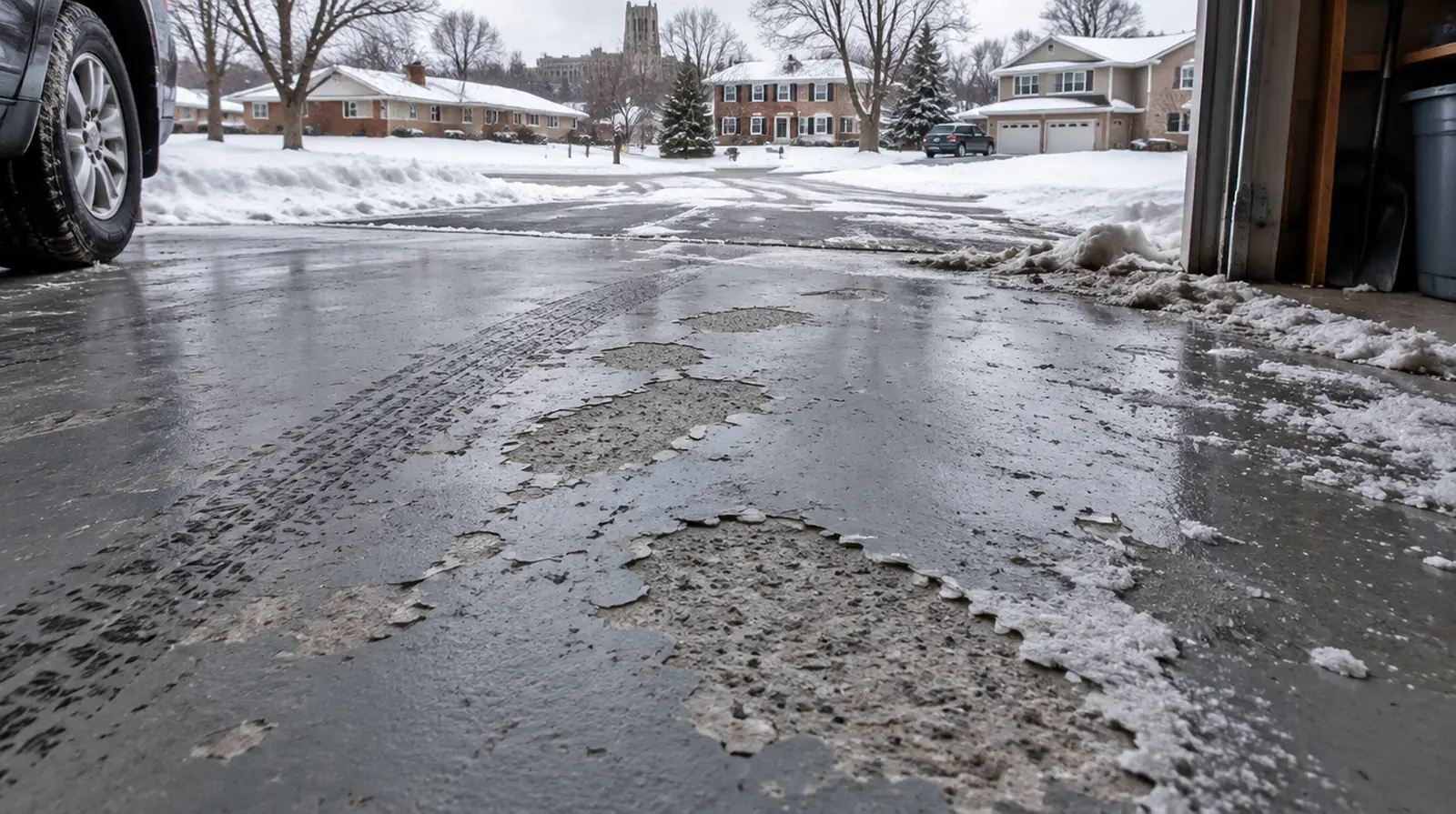
Why coatings fail here
After many repair calls, we see the same causes again and again:
- Poor prep: a coating rolled over unground or acid-etched concrete with no real bond.
- Hot tire pickup: thin coatings softened by warm tires and pulled up when the car leaves.
- Moisture: vapor pushing up through older slabs with no barrier, causing bubbles and lifting.
- Salt and freeze-thaw: chloride water getting under a cracked coating and scaling the concrete below.
- Wrong product: one-part paints or thin kits that cannot handle heavy use.
Repairing a floor without fixing the cause just leads to another failure, so diagnosis always comes first.
Our inspection
We look at where the coating is failing, test adhesion in sound areas, take moisture readings and check the concrete underneath. Peeling at the tire paths points to hot tire pickup or poor prep. Bubbles and blisters across the floor suggest moisture or outgassing. Flaking near the door often means salt got under the coating through cracks. We explain what we find in plain language.
Spot repair or full removal
If the original coating is well bonded and the damage is limited to a few areas, we can grind out the failed spots, repair the concrete and blend in new coating. Color matching an older floor is not always perfect, especially with flake, so we discuss how visible the repair will be. If the coating is failing in many places, removing it entirely and starting over is usually more cost effective and gives a better long-term result.
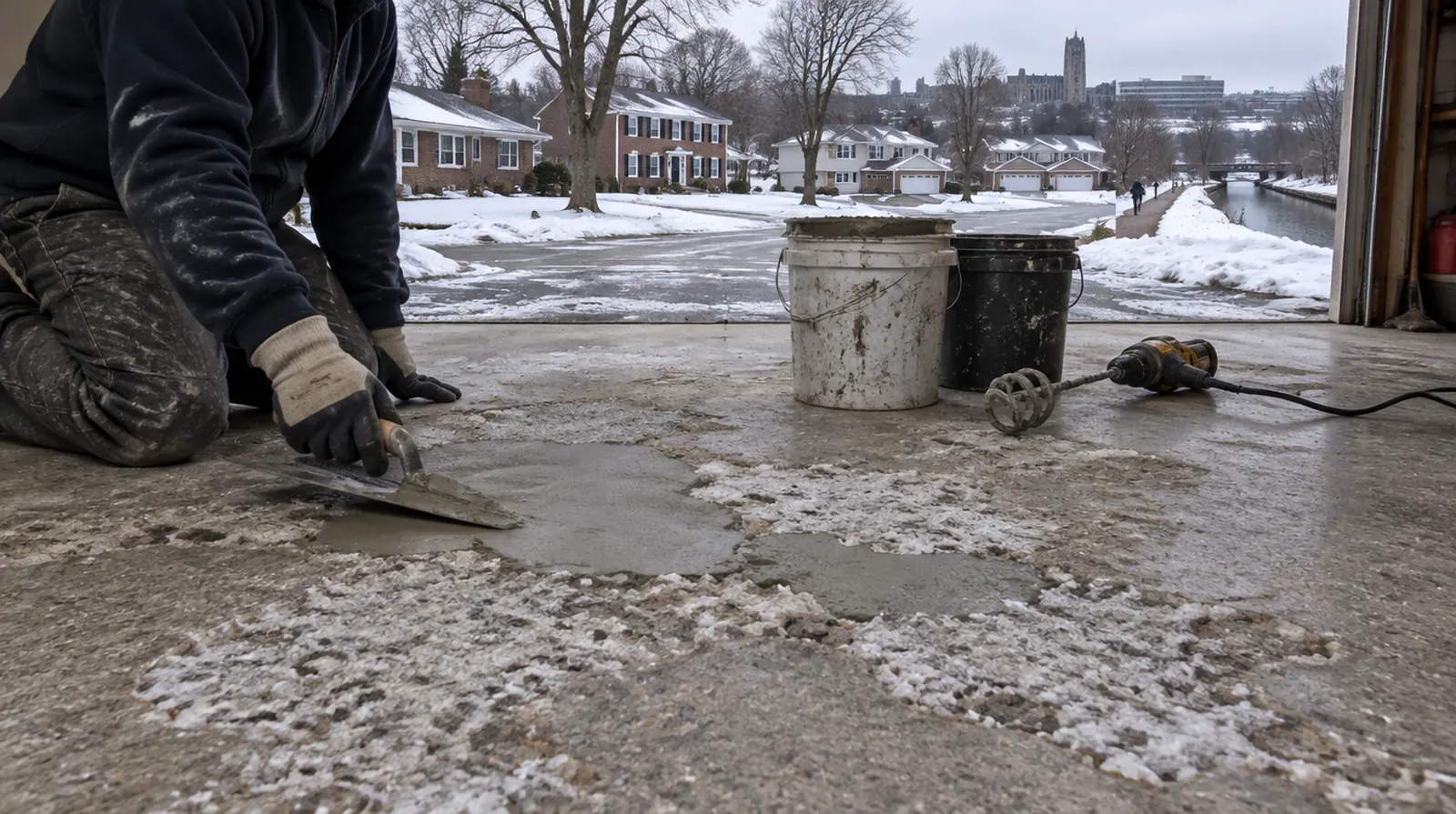
Repairing the concrete
Once the old coating is off, we deal with the slab. Salt-scaled and pitted areas are filled with resin mortar and leveled. Cracks are routed and filled, using flexible materials for those that move with temperature. Broken slab edges at the door are rebuilt. Spalled areas around drains and joints are patched. If moisture is the problem, we install a vapor-mitigating primer before the new system.
Recoating
With a sound, ground, repaired slab, we install a full coating system: primer, body coat, optional flake and a durable clear top. We choose products based on what caused the first failure. If hot tires were the problem, we use thicker build and harder topcoats. If moisture was the issue, we use a primer rated for higher vapor levels. If salt damage was severe, we make sure every edge is sealed.
Fixing older epoxy that is just worn
Sometimes a floor is not failing, just tired. The topcoat is scratched and dull, but the coating is still bonded. In those cases, we can screen the surface and apply a fresh clear topcoat. It is a fast, affordable way to restore shine and protection without a full redo, and it can add years to an older floor.
Commercial repairs
Businesses often call us when a warehouse coating wears through at forklift lanes, a kitchen floor cracks around drains or a lab floor loses its chemical resistance. We can repair sections after hours, reseal joints, rebuild cove bases and recoat in phases. For large-scale failures, see our commercial flooring page.
Send us photos
Photos of the damaged areas, the full floor and any product labels you still have help us understand the situation before we visit. We will give you a clear explanation of the problem and a written estimate for the repair. If you also need a new topcoat, our polyaspartic option cures quickly.
Basement floor failures
Many basement coatings in older homes were applied right over a damp slab with no testing. The result is blistering, white powder pushing through and paint that lifts in sheets. We remove what has failed, test moisture over several spots and choose a primer designed for vapor drive. If water is actually entering through cracks or the wall joint, that needs to be solved first, and we will tell you so.
Whatever the cause, you will know exactly what failed and what we are doing differently this time before any work begins.
to fix a failing floor.
Call (716) 296-6345 for a free estimate.